Lappieskombers

M A R L A   G R O V É

27 Marla Grové  27 Quilt

I am a 3rd year Social Work student at the University of Pretoria, South Africa. I am also the Chairperson at the University of Pretoria Student Social Work Association.

I am studying to become a Social worker because I have a passion for people from all walks of life. Also I have a personal story that will inspire and help people believe in a better tomorrow. My inspiring story involves a very rebellious teenager from divorced parents, one that got involved in very destructive activities. Still, regardless of all the cards that were dealt, I managed to stand up out of my situation and make a better life for myself. I am half-way to the top with no intention of stopping; bigger, better things are yet to come.

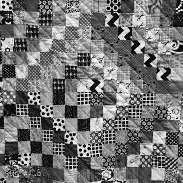
I chose Lappieskombers (Afrikaans for Quilt) because … 

… Making a quilt needs proper planning, patience, off-cut pieces of material, thread and a skilled hand putting it all together.

Quilts are made to keep you warm and will brighten up anyone’s day with all the different colors, but most importantly a quilt brings little pieces of off-cut materials together to form a big, beautiful, colorful masterpiece.

Social workers are the same; one of the first things we are taught is that social work is a multi-disciplinary profession, we need other professions like psychologists, doctors, psychiatrists, nurses, teachers ect. to empower our service users to become the best they can be, just like a quilt needs a lot of different pieces of material.

Each piece of material already possess the potential to be something beautiful, someone just has to unite it with the other pieces. This links directly to our service users – we are the thread that links them with other professionals when needed, but the material (service user) already possesses the real beauty, all we need to do is to show them the personal power they have inside of them.

Pint of beer

P A U L   S T A P L E T O N

26 Paul Stapleton  26 Pint of beer

I have worked for over 25 years in social work, as practitioner and senior manager in adult social care, for both local authorities and the voluntary sector. My special interest, over this time has been working with and supporting adults who have severe learning disabilities to lead as independent lifestyles as possible. My work is rooted in the principles of normalization, and over the last decade person centred approaches. I have also acted as a practice educator for social work students for the last 15 years, both here in the UK and abroad. I have undertaken research with local Universities and service users on a range of issues. I am currently a Senior Lecturer in Social Work at Sheffield Hallam University, and take a lead role within the area of practice education.


I chose Pint of beer because …

… as a practitioner, in years gone by, I have listened to, helped and supported many service users over ‘a pint’ in a pub. Having a pint has symbolised normalization, living a valued lifestyle, having something in common with another person or persons, being down to earth, and being on the same level (ant-oppressive practice values). It has provided social interaction, built, and indeed gained trusting relationships (empathy). Having ‘a pint’ has provided an atmosphere to solve problems (task centred practice and indeed strengths-based practice). It resonates with social work.

It can symbolise how we and service users view life, is the glass half full or half empty? Having a pint generates commonality, fun, pleasure, and the simple things in life, which service users, particularly those with severe learning difficulties, so often get little opportunity to enjoy (Valuing People principles).

These days, strict rules about alcohol and drinking at work mean that this way of working (having a pint with a service user) has become frowned upon, and indeed outlawed by organisations. Therefore developing professional and trusting relationships with service users is perhaps now more restrictive; or with a bit of creativity (an orange juice instead?), the glass can become half full.


Lego aeroplane

 M A R G U E R I T A   M c G O V E R N

aeroplane builders:    S I N E A D,   A I N E,   S I O B H A N   and   R A C H E L

25 Students   Lego aeroplane

Defining social work in metaphorical terms has always been an interest of mine with social work students in class groups, whether that is in the form of mask-making, Lego Serious Play or this representation of defining social work in the form of an object. I did the ‘make an object that represents social work’ with a class a few years ago. Some of the most memorable were a large rubik cube to represent all the different settings, peoples and skills of the social worker, a justice scales with the two weighing pans at each side representing the weight of human rights and social justice and the third one was a beautiful picture drawn by the MSW group of an eye, to represent the eye of the social worker, the eye of the client/service user and the eye of society. It was a good class as you can imagine!

I’m Fieldwork Co-ordinator for the Masters in Social Work course at National University of Ireland, Galway.

I’m proposing this Lego aeroplane made by a small group of social work students (Sinead, Aine, Siobhan and Rachel) because …

… Recently, using Lego Serious Play a sub-group of the MSW class built a metaphorical model of an aeroplane representing social work. You can see from the photograph how they put the new social worker and their supervisor flying to the agency setting. The graduate is the one in the driving seat and the supervisor is directing the new graduate in what to do. There are a number of hats on show. A crown (for when the graduate gets things right). A Top hat for when the graduate has to present themselves at important meetings and a crash helmet when the graduate finds themselves in ‘sticky’ situations. The model also has uneven steps for passengers to get on the plane and this represented the difference in service user problems and the unevenness at times of the graduate’s knowledge. The plane also has a part in the back for ‘baggage’. This belonged to the graduate! The tubing overarching the two front seat passengers represents flexibility in learning and both parties having to adjust to possibly different styles of learning. There is a bush (out of sight of the photo) – a metaphor for growth in knowledge which takes place throughout a social worker’s career. The model finishes with two jet packs at the back of the aeroplane for a boost in self confidence whenever it’s needed.

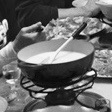
Cheese fondue

   D O M I N I Q U E   M O Y S E   S T E I N B E R G

24 Dominique Moyse Steinberg   24 Cheese fondue

I think I got into social work because to do something less meaningful would have been a terrible disappointment to my elders. I actually have a degree in interior design, but my parents made quite a long face when they thought I might pursue that career for real instead of some kind of social service. However, my grandmothers were both uncredentialed social workers, and ultimately I’m sure that they heavily influenced my ideas of what would be “right” and “wrong” to do in life. My paternal grandmother saved every bird, cat, and other small animal in trouble in any neighborhood in which she lived, and my maternal grandmother saved every woman, man, and child in trouble in any neighborhood in which she lived! Together, they were an impossible force to go against. Not that I am unhappy with my choice of social work. It’s really a perfect fit, whether I’m setting the stage for a cheese fondue or setting the stage for any other kind of group that is of mutual aid.


I chose Cheese fondue because …

… I see group work as central to social work and a cheese fondue is the quintessential group experience. Not only does everyone get to do something to help while the central cook stays at the pot on the stove, stirring always in one direction and not able to leave (or the cheese will separate), but then everyone shares from that pot to eat it. This is like setting the stage, getting all group members involved (and thus engaged) in preparation (like cutting the bread, opening the wine and kirsch, and lighting the fondue lamps), and then everyone partaking in the final result (and having to share the pot, trust that no one else has hoof and mouth disease, not eat more than his/her share, pass the bread around, etc. etc.)

My parents – musicians and very social folks, along with my grandparents who lived with us – often had parties after concerts or with their college students or musical colleagues. When it came to entertaining … fondue was always in order! I wonder if anyone had ever even had one in the US before my family came here, fleeing the ravages of WWII in 1949 after a brief but devastating stint in South America. Whatever the case, a cheese fondue evening at the Moyses became emblematic of a great group time, and I inherited not only their love of good groups, but love of good parties and especially, being at the center of a delicious fondue and setting the stage for a delightful party to go with it.

Cue / Radical Social Work

P E T E   N E L S O N

23 Pete Nelson   23 Cue/Radical Social Work

When asked ‘what is it you do’ we often reply with what we do as paid work. Yet all of us have much richer lives than our work. I ski, cook, garden, read poetry, listen to music and climb mountains and for quite a while after leaving university with a philosophy degree that is exactly what I did – climb mountains, working in a fish factory in Hull, and undertaking labouring jobs to fund trips. There followed a misguided dabble with becoming a solicitor before someone asked me what I was interested in – law or people. It was people and there then followed a move away from the law as a profession to psychiatric nursing, residential social work, fieldwork and practice education. I spent seventeen years practising social work, catching the tail end of patch work and genericism before spending most of my time in child protection. I loved the job and I also loved working with students on placement and gradually social work education started to dominate such that I made the move to working full time in universities. I am currently Principal Lecturer in Social Work at Sheffield Hallam University. What do I do there? Well I teach, but not as much as I would like; I research, currently around public health issues such as fuel poverty and obesity and the interface with children and safeguarding; and I ‘manage people’ as current jargon would describe the activities of organising social work education. People – students, colleagues and research participants – remain where my interests lie, but I still climb mountains.


I chose a pool Cue resting on Mike Brake and Roy Bailey’s book Radical Social Work book because …

… Well, this might seem something of a cheat – two objects for the price of one – so I’ll need to explain how a book and a pool cue can go together like a cup and saucer.

My early career was spent as a psychiatric nursing assistant in a large psychiatric hospital dating back in parts to the Napoleonic wars, followed by three years as a residential social worker with children working in a reception centre on an estate in a large urban city. Both settings could be challenging places to work, emotional distress would manifest itself in violence and aggression and the tensions between care and control were played out on a daily basis. In the early 1980s and perhaps still to an extent today, it seemed odd that the least well trained, paid and qualified work was in some of the most challenging situations. It was important to learn quickly. Central to everything I did was building a relationship with the patients and young people and I soon learned that the way to do this was talking to people. I also learned that the least effective way to build a relationship was talking to people across a table whether in an office or a café. What worked much better was doing things with people, sharing an activity or playing games. Hence the pool cue; in working with young people in particular I played a lot of pool. Talking to people and building relationships in my view remains fundamental to social work. If people won’t and don’t talk to us then all the assessment tools and systemic practice in the world are of little use.

Social work is an activity, but it is also a thinking one which is informed by theory and research and which does not take place in a moral or social vacuum. Working in residential social work I struggled to make sense of the psychotherapeutic models of explanation dominant at the time. Dockar-Drysdale spoke of ‘frozen children’, which perhaps made sense in the therapeutic setting of the Mulberry Bush but made less sense on a large industrial estate where children could be frozen through poverty as well as emotional development. We are more than our work and at the time like many men on the political left I was struggling with the challenges feminism made to Marxist thought. The notion that ‘the personal is political’ was much discussed and it was in this context that I came across radical social work. For me it wasn’t the seminal text by Bailey and Brake that had most impact but rather their second text and in particular a chapter by Phil Lee and David Pithers Radical Residential Child Care: Trojan horse or non-runner? These days I would probably disagree with quite a lot of what is written there but that isn’t the point. What was so exciting was the application of political ideas to the work I was actually undertaking and an attempt to develop a theoretical understanding of that work which resonated with the lives of service users. The text provided a theoretical underpinning for the pool cue. To extend the metaphor it was the rest which allowed difficult balls to be reached. Radical social work shone and faded but for me the ideas still resonate in critical social work texts, still provide a challenge to bureaucratic management systems, still provide a challenge to apprenticeship models of social work education and Roy Bailey still sings radical songs.

Love and Marriage go together like a horse and carriage sang Frank Sinatra but feminism taught us the error of that line. A pool cue and a radical social work text however – for me they will always go together.

Glass paperweight

 J O    L U C A S

Jo Lucas  Paperweight

My first social work job was in a residential psychiatric hostel in London and I remember feeling that I had been given a sticking plaster to try and heal huge wounds. I went on to train as a social worker at London Sschool of Economics and worked in a wide range of settings always with a mental health focus. I then spent 20 years working in Ukraine and Georgia helping establish university level social work education and the new profession. I now practice as a psychotherapist, having completed more training, as I feel that I can really see changes happen which then ripple out into peoples lives, families and their communities.


I chose Glass paperweight because …

… the swirl of different threads that make up the inner core reflects the role of social work in creating a whole strong rope for the person/group/community, with all sorts of different strands, all of which enable the person/group/community to make their way into whatever future they aspire to. The range of forms within the paperweight also reflect the different aspects of social work – from academic theorizing and policy to practical support for people in distress. The paperweight itself symbolizes the strength and solidity of the profession and its history, the fact that it is spherical reflecting its ability to roll with changes. I am aware as I write this that I am displaying a certain optimism, I know from people practising as social workers now that this might not seem to be a reflection of what they are currently engaged in. I entered the profession some 40 years ago with an aspiration to change the world, to redress some of the social injustices and unfairness I saw around me and still think that is an important aspect of the profession.


Coffee cup

   L O R R I E   G R E E N H O U S E   G A R D E L L A

21 Lorrie Greenhouse Gardella   21 coffee cup

I entered social work as a settlement house volunteer, where I enjoyed working with children of various ages and learning about social work with groups. I studied law and social work, and I served as a consultant in children’s law and as a social worker for adults with developmental disabilities, before beginning my career in social work education. As a professor and college administrator, I have sought to improve educational access for underserved populations. My basic understanding of social work practice arose from my early volunteer experiences: 1) the client comes first; 2) in children’s games, stop at the peak of interest; and 3) every person deserves a friend.


I chose coffee cup because …

… Many years ago, my father and I stopped on the way to work at the Oh Boy! Luncheonette, a tiny coffee shop in a down-at-heal industrial neighborhood.   Every morning at 5:30 a.m., the same eight men were drinking coffee in the Oh Boy, exchanging jokes and barbs with red-haired waitress and with one another. They saw each other only there and then, but through the years, they had learned about each other’s families, jobs, hobbies, and milestones in life. When the owner’s daughter was married, they all attended the wedding. It was a naturally occurring group.

Today the Oh Boy! is gone, but a Jamaican grocery is thriving in its place. Perhaps the same dynamics apply. In various coffee shops and diners, regular customers take their customary places, sometimes talking with one another, sometimes just nodding hello, depending upon the ethos of the place. The moments of familiarity offer the possibility of belonging. We social workers create possibilities of belonging, where they might not otherwise occur.

Real life library

     J O H N   D O W

20 John Dow   20 Real life library

During social work qualifying education, and afterwards when the students become the ‘practitioners of tomorrow’, we are all looking for (longing for?) social workers who can deliver the type of personalised services that me, and others like me, need.

What do social workers need in order to guide and influence them as students, and practitioners?

Well, for me, they need to be able to rely on all the knowledge and information at their disposal. This is often within the fantastic libraries within the universities, or other libraries they can access, to ‘keep informed of changes in regulations’ and to be able to know what service users and carers like me need. So how do me and others like me fit in to this continual search for knowledge?


Well, I chose Real life library because …

I believe that me and others like me who ‘require to use services’, we are the real life reference library.

We need to be ‘accessed’ alongside all of the books, publications, policy documents and regulations. We can be this real life library (who won’t charge you or fine you for late returns), who will be a library of real life information. We can all begin to see ‘real partnership’ and, from this, real and sustainable influence from our involvement. We can together continue on our ‘journey as key, valued partners’ and begin to see, as we all want to see, real, personalised services where we appreciate each other’s passion, knowledge and commitment to delivering the services that are needed.

Esculape

N E I L   T H O M P S O N

19 Neil Thompson  19 Esculape

I began working life in residential child care before training as a social worker. After a career spanning five decades, I am now focusing my efforts on writing and the development of online learning resources. I run the Avenue Professional Development Programme, an innovative online learning community geared towards self-directed learning and reflective practice (www.apdp.org.uk). My latest book is The Authentic Leader (Palgrave Macmillan, 2016), and I have also produced a number of e-books, with several more in the pipeline. You can connect with me online through my website and blog at www.neilthompson.info.


I chose Esculape because …

… This bronze figure was given to me by a Dutch colleague to thank me for helping him with his social work toolbox book. It depicts Esculape, the Greco-Roman god of healing. Wooden versions are produced by families in Senegal, but this bronze version was sculpted to serve as an image for the book cover. As well as appreciating it as a beautiful piece of artwork, I am very fond of this object because of its strong symbolism. One of my main areas of interest is loss, grief and trauma, so the fact that it represents healing is very significant. There is also the symbolism of providing support (is that the world they are holding up?). The way two people merging into one is represented is also of interest, suggesting that we put our individual concerns to one side and work together – supporting each other to enable us to support others too, which is very much what social work is all about. The fact that it was a gift, from one social work professional across national boundaries to another, in a spirit of shared scholarship, also adds meaning to the piece for me.

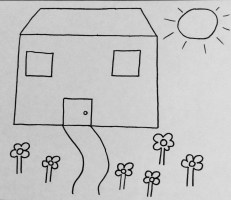
Outline of a house

 C A T H E R I N E   G R A Y

Catherine Gray  18 Outline of a house

I think I first used the phrase ‘social work’ when I was writing my first job application back in 1989. At the time, I didn’t know what a social worker was but social work seemed an appropriate term to describe the voluntary work I’d done as a teenager with disabled people, first at a riding-school and then at a primary school. I’d also just begun volunteering for Crisis, the homelessness charity. For a series of 12 Christmases, I stood in the cold of a central London warehouse and understood first-hand the importance of hot food, a roof overhead and a listening ear for people whose lives had been shattered by the loss of their home and everything connected with it.


I chose Outline of a house because …

… Social workers work with many forms of outline, diagrammatic and verbal. Some are descriptive in function, some serve the purpose of an agenda or checklist. I like the outline of a house because it encapsulates both human need and human aspiration. It appeals to our sense of the universal. In outline form, a house symbolises what Gaston Bachelard calls ‘our corner of the world’ – a place we can be ourselves in and to which we can always return. It also invokes the material space of people’s lives. Walls, floors and furnishings all carry the traces of our actions and relationships – whether marks and worn patches made by movement and usage, or choices of objects and furnishings influenced by need, taste or budget.

Typically, a house is one of the first things a child might learn to draw. So the outline of a house can be a tool for social workers talking to children about the significant figures and events in their lives, what makes them feel safe or scared. Indeed, the idea of a house speaks powerfully across the life course: to young adults aspiring to have a home of their own, families on the move across continents fleeing bombs, hunger and terror, or old people fearful of giving up their houses to go into care or struggling with isolation living alone. Of all the professions, social workers understand the secrets of houses, what acts of love, care, violence or neglect can be hidden behind their walls.

As a publisher (and I’ve now been publishing in the field of social work for over 20 years), I deal with outline ideas all the time. An outline is just a beginning. It is an idea that can be subjected to scrutiny and interrogation, a plan that can be adapted and revised. An outline of a house allows us to ask whether what we are talking about is suited to the person and their circumstances. It does not, for instance, suggest a community with neighbours looking out for you. Its conventional features show no understanding of a disabled person’s needs. In the mouths of politicians, the idea of a house sounds like a promise aimed at a certain sector of the electorate. In our age of insecurity and crisis, we may be constrained by resources but not by empathy or imagination. So I propose an outline of a house as a symbol and a tool for social work, a form of aspiration and a call for social change.