Pen

   E V A D N E   V A N   D E N   B E R G

99 Evadne van den Berg   99 Pen

I am nearing the end of a wonderful four year journey as a social work student at the University of Pretoria, a journey that has taken me out of my shell and allowed me to develop into not only a social work professional, but a caring, resilient, and sometimes too sensitive human being.

I am fortunate enough to have been placed at a school that caters for learners with severe intellectual disabilities, as my final year field placement. Every day presents itself with a new learning opportunity, and I believe that I am extremely privileged to have been given the hearts of the most vulnerable to take care of. The profession has already changed me on so many spheres of my life, and I have learnt that nothing in life can be taken for granted.


I chose a Pen because …

… a pen can be found in various colours, shapes, types, and is universal! Just like a pen, all social workers are different and are used as instruments that leave a mark on the lives that we touch. Although our core is a pen, our structures, i.e. specialisations, talents, knowledge, personalities, and origin make us, and the marks we leave, unique.

Being a pen is tricky, as we always have to set the example and be careful not to leave a negative mark, as a pen mark is difficult to erase. We might sometimes not even know that we have “marked” someone, because actions speak louder than words, and then again word spreads like wildfire. If one negative mark is made on an individual, all will know about it. On the opposite side, we also leave life making marks that bring change and hope to those who have been scribbled and scratched on. With some individuals we have to push a bit harder and indent the paper for our mark to be left and eventually noticed, and with others we just glide across the paper, but we leave a lasting mark regardless.

Unfortunately our ink does not last forever, and we sometimes need to be refilled, which I have found to be one of the biggest challenges that social workers face. One cannot only give and not replenish your ink levels, but self-care, proper debriefing, writing, and lots of praying have proven to be very beneficial for my ink levels.

There is however one similarity of a pen that I do not completely agree with. Pens are constantly lost, and easily replaced …

You are not replaceable, and no other pen can leave the mark that you do on the lives of the individuals that you touch. Pens should be taken care of, and be appreciated for their hard work and dedication.




Mental Health Act (1983)

   T O N Y   D E A N E

46 Mental Health Act

Like many others I sort of fell into social work by happy design and accident.

I was born and raised in the North of Ireland, at the height of the Troubles and in an environment within which I was encouraged to ask the what, why and where questions, and to question authority in its various guises. It was an interesting place to learn about issues of social justice and oppression and inequity and stuff … not all the learning was good, by the way.

Thanks mostly to my mum, I was lucky enough to attend a school that tried very hard to inspire and add value to the young men it got. As a youth I had hoped to go to university to read History and Politics (at a proper ‘red brick’ one). However, as a youth I was much distracted by what life had to offer and my ‘A‘ Level grades suggested a different path.

I knew then that I didn’t want to work in a bank or be suit and tie type of guy, but I wasn’t actually sure what I wanted to be or do. My first work experience was two weeks at a local alcohol rehabilitation unit, where I basically made tea and played football with the men undergoing treatment. However, I also got to hear people’s life stories and the whole experience left an indelible mark on me. People’s family histories very often reflect so much about how society and social norms change over time.

So in 1988, towards the end of a certain Prime Minister’s reign and after the miners’ strike and by happy accident I ended up in a northern English (steel) city at a Polytechnic doing a Social Science Degree. I then did post-gradaute training to qualify in social work (ever the student, avoiding responsibility and filling my mind with all sorts of things – and my belly with beer).

By then, in a different English city, I knew that I wanted to be a Mental Health Social Worker and, having gained the experience required, there I was, in my chosen profession.

If you were going to be a Mental Health Social worker it was an Approved Social Worker (ASW) you aspired to be. These ASWs knew their stuff and they were capable and knowledgeable, and the bosses mostly left them to it. So, after more schooling, I was an ASW and I am now an Approved Mental Health Professional (AMHP).

Being an AMHP is at times an almost impossible task and we are almost invisible, stuck in a twilight zone between Local Authorities and the National Health Service. Most people have no idea what an AMHP is or does.

Being an AMHP is always interesting and often challenging. It is sometimes very difficult, upsetting and distressing, and sometimes just ridiculous and sometimes just very funny.

It is also a privilege to be an AMHP, as the role gets you invited into other people’s lives, often when they are at their lowest ebb. It’s a role in which others are all too keen to tell you what you need to do; however, more often than not, the people instructing or indeed obstructing have never actually read the Mental Health Act (MHA) or Code of Practice (CoP).


I chose the Mental Health Act (1983) and the Guidance because …

… taken together with the Jones MHA Manual, the Code of Practice and the ‘Pink Forms’, these are all the tools of our trade and it is by knowing these and using them skilfully that the AMHP can ensure that a person’s rights are protected and that they (and sometimes others) are kept safe. The MHA allows the state to remove a person’s liberty, but only through a prescribed process and only if it is thought necessary.

A Mental Health Act Assessment (MHAA) is many things, but it is also a legal process and it is the AMHP that is tasked with coordinating that process. AMHPs have many duties and responsibilities, and the lawful power to remove a person’s liberty, if that person meet the criteria for detention. However, the starting point and the Guiding Principles of the MHA mean we should be starting the journey somewhere else. I have become concerned that psychiatry has become overly reliant on the MHA and coercion; AMHPs can make a difference in this regard.

AMHPs are not perfect and we get it wrong. It is not an exact science. However an AMHP that understands the law and the Code of Practice and an AMHP that can apply that knowledge in the real world is capable of doing a very difficult task well, and of ensuring that people are treated with dignity and afforded the rights that the rest of us take for granted.

AMHPs come in all different shapes and sizes, and from very diverse backgrounds and creeds. We are all different and I like that we are an eclectic mix of individuals. We are not what people assume and it is our job to ensure that the law is complied with.

So my objects allow me to do difficult job as well as I can. They are to be used every day and not left to gather dust on a shelf.

Enigma

   A N G I E   L E W I S

45 Angie Lewis   45 Enigma

I am a relatively newly qualified social worker, having qualified in 2013. Prior to this I had worked in the social care sector for around ten years. My experience includes working with older people, children and families, young homeless people in supported accommodation, forensic learning disability, and now adult learning disabilities in Aberdeenshire, Scotland. I enjoy problem solving, embrace change, and am a creative and dynamic thinker with an affinity for thinking outside the box. I am naturally good at communicating and love meeting new people from different walks of life. I never see problems, only challenges. And in my spare time I can be found relaxing with friends, enjoying a pint or partaking in some form of adrenaline-junkie activity.


I chose The Enigma because …

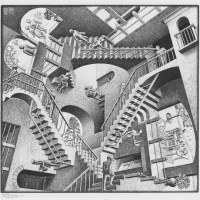
Well, it is not an object as such, but The Enigma by Escher kind of defines social work for me: not everything is as it seems and depending on perspective, we may all see things differently. The work we do, and in particular assessments, are so subjective. For me The Enigma highlights the multifaceted dynamics in any one situation or person’s life. When and from where we walk into this picture will determine what we see, where we see it, what we perceive to be reality. However, this entrance and timing and observation will always be determined by which of the people and in which position they are on the stairs. The direction is not always so easily determined and this fits well with my liking for thinking creatively and outside of the box. We all too often find ourselves as practitioners entering the lives of people in times of crisis and chaos, stumbling down the stairs. But thankfully by the time we have done all we can, people once again are climbing back upwards. Life for any of us is never plain sailing, but as long as we all do our best to find our own way and help those we can, then balance will always be restored.

I had originally chosen Pandora’s Box; however, this did not give the opportunity for any positives to be highlighted, simply representing all the evil in the world. But if you look hard enough, there are always positives to be found! Every cloud has a silver lining and all that …


Cardboard box

   M A R T I N   C A M I R É  

44 Martin Camiré   44 Cardboard box

Over the past years, I’ve worked in the streets, in shelters, in treatment centres and in hospitals. Throughout those experiences, I always felt that I was privileged to work with people.

But after 10 years of practice, I became obsessed by two things: how come some people don’t have access to care and how can I improve my practice in groupwork. So I made the unfamiliar choice to become a manager and to complete a Masters in Social Work at the same time. On one side I thought my skills as a leader will be helpful to move things around for the clients and to act as an agent of change. On the other side, going back to university was a way to improve my knowledge and my skills about groupwork practice.

My journey in social work is far from ending. Now my principal occupation is to lead different projects  about addiction, mental health and homelessness in Québec, Canada. And I also give supervision and training of groupwork practice.


I choose Cardboard box because …

… like social work it’s been around for years. The first commercial cardboard box was produced 200 years ago (1817). Cardboard boxes comes in different shapes and sizes. Easy to find, it can accomplish many different tasks, some are precise and short term, other are over a  long period and for multiple purposes. The production of a cardboard box is quite simple, even if its use can be quite complex.

But, the cardboard box is not always receiving the respect it should deserve. Sometimes people think well, it’s only a box! They focus on the appearance over its use, content or surprising potential. Ask kids, they will show you the potential! And what about outside the box … have you ever thought about that?!

So a cardboard box has a wonderful potential: It can shelter, it can be a game, it can be a useful way to move things. It can be used to bring food, to offer gifts, to keep secrets … and what about the essential miscellany box that accepts things that are diverse and disparate, things that have difficulties finding their own place and space … or the lost and found box that takes care of those that are abandoned, neglected, forgotten? For a homeless person on a cold night a Cardboard box can save a life.

Like social work, I think that our imagination is the only limit of a Cardboard box.

Like social work, Cardboard box can make a difference, even a life saver.

Book stand

   J U L I E   M A N N

Julie Mann Plymouth – Version 2   Bookstand

I can still remember distinctly the feeling of having ‘found my home’ professionally when I started out as a trainee social worker in London more than three decades ago. That feeling has never gone away and despite the hard times social work has gone through and is currently facing, have always been proud to call myself a member of this profession. Currently I am a Lecturer in Social Work at Plymouth University. I love working with the students, learn so much from them and find them continually refreshing and reinvigorating (usually!) I hold the Practice Teaching Award (remember that?) and have co-led training for Practice Educators for several years at the university.


I chose Book stand because…

… as a trainee social worker one of the first people I ever worked with was a young Black lad who was in trouble with the police. I had to write a report on him for the court and accompanied him there for the hearing. When our work together had finished and I was saying goodbye to the lad and his family, he presented me shyly with a book stand, which he had made himself. I was incredibly moved. I know we are not allowed to accept presents, but it would have been completely disrespectful and discourteous of me not to do so.

For me this book stand and the person who made it represent all that social work is about. Despite the reason I had come into his life, the lad and I made a connection based on mutual respect and humanity. The family’s poverty had shocked me, but the warmth they displayed to each other and to me, humbled me and made me, the rookie, realise that (most) families try their hardest to make the most and best of what they have, even when that is very little. The fact that this lad had taken the trouble and had the skills to make the book stand showed me that everyone has their own take on the world, their own feelings, strengths and aspirations, you just need to make sure you see them. It was also the beginning of my awareness of structural inequalities and racial discrimination.

The gift of this book stand and all that it represented offered me a foundation on which to build my social work practice. I have literally carried it with me through several house moves and also metaphorically through my social work career and will never forget that young lad and his family, who taught me so much.

Ball of wool

  Y O L A N D A   D O M E N E C H   L Ó P E Z

42 Yolanda Domenech   42 Ball of wool

I am a social work lecturer in Spain. My lines of research and teaching are social work with groups, skills for social workers, poverty and social exclusion, social services and social work in Spain. I have a PhD in sociology. Currently, I am the Director of the Department of Social Work and Social Services at the University of Alicante (España).


I have chosen Ball of wool because …

… for me, it represents social work with groups. Like the web that spiders knit, a ball of wool permits the knitting of a support network. The group as a support network in social work practice is the basic premise that I use to teach social work with groups. Professionally, social work with groups has and remains a challenge to some aspects and areas of the profession. Because of that, we need to teach the importance of “knitting” the group, as if with a ball of wool.

Shoes

D A V I D   H O W E

   41 David Howe    41 Shoes

My social work career began as a child care officer in 1969. In the wake of the ‘Seebohm’ reorganisations of social work in England and Wales 1971 I evolved from being a child and family specialist to a generic social worker overnight. In 1976, after a short spell as a senior social worker I was appointed to a lectureship in social work at the University of East Anglia, Norwich on the newly established MA qualifying course. And that’s where I spent the rest of my social work career – happily teaching, writing, researching. I am now retired but still live in Norwich, doing the odd bit of writing, giving the occasional lecture, and carrying out a small amount of advisory work.


I chose Shoes because …

… for me it evokes memories of what brought me into social work in the first place and triggers feelings that have sustained my commitment to the profession ever since.

Bridget had just turned five. She was the eldest of Beverley’s three children. Bridget’s mother had arrived in the UK from Jamaica two years earlier to join her husband but he deserted her only a few months after she had left the Caribbean. Knowing no-one, short of money and living in a small, Victorian terraced house with three small children, Beverley sank into a depression. She followed the advice of her GP and psychiatrist and agreed to go into hospital for a few weeks. It was December 1969. The Children’s Department was contacted and as the child care officer for the case, I arranged for the children to be placed with short-term foster carers. Mum, slowly and with effort, managed to get the children ready. It was when I came to collect them that I noticed Bridget struggling to put on a pair of old, very worn, buckle sandals, hopeless for winter wear. They were too small but they were the only pair of shoes she had. As Mum looked on with a blank face, the gloomy little room felt even darker, drained of energy and hope.

Bridget was deaf. Her mother had gathered her hair into two bunches and tied them with white ribbons. Bridget, though, had a smile that could light up any room and would melt your heart. And she smiled a lot. The welfare assistant and I took Bridget into the city centre and bought her a new pair of shoes. She chose the brightest red pair imaginable. She couldn’t contain her excitement and the beam on her face didn’t leave until we arrived at the foster home

This was one of my first cases. Beverley’s life as a single parent was an early introduction to the sapping effects of what alienation, poverty and loneliness could do to a young mother and a family with few supports. In the event, Bridget and her baby brothers stayed with the foster carers for nearly three months. The foster mum fell in love with Bridget and her beautiful smile. Who wouldn’t? The little girl insisted on wearing her bright red shoes every day. Bridget spread joy wherever she went. She laughed when I showed her a small hole in my shoe and then pointed cheekily to her own brand new pair. Working in an inner city area, I could walk to most of my home visits. There was no shoe allowance but the gradual wear and tear marked the passing of the year, the cases visited, the streets walked.

Empathy is often defined as the ability to think ourselves into the shoes of the other. We cannot know another, so the saying goes, until we have walked a mile in their shoes. To know something of Beverley’s story, to put yourself in her shoes was to begin to know her. And to imagine being five years old and choosing a pair of shiny red shoes is a reminder that joy is infectious and the smallest acts can bring hope, hope and understanding, in lives that all too often are mired in despair and rejection. I often think of Bridget. She will be in her early-fifties now. I wonder if she’s still smiling. I hope so.


Jeans

    M A R Y   T H O M S O N

Christmas drinks – Version 2

I qualified as a social worker in 1982 and I work currently as a frontline social worker. As you can imagine I have seen many, many changes.


I chose Jeans because …

… they represent for me social work before the managerialism of the 1990s transformed social work into a corporatised, homogenised, depersonalised and overly regulated profession.

Jeans represent the time when workers did not hide behind a badge that identifies them as being somehow different from and superior to the people with whom we work.

It represents a time before we had created an industry to service a resource.

It is stated that social work is unsustainable beyond the year 2020 and I would state that the reason for this is the exponential increase in the number of staff now employed to tell us that there is no room for the relators and motivators from whence social work traditionally drew its staff and has now replaced this with the processors and producers who are more concerned with meeting deadlines and targets than in authentically engaging with people in need.

It is time for the men and women in suits to give social work back to the men and women in jeans!


Crown coin

  M I K E   S H A P T O N

Mike Shapton   Crown coin

I obtained my qualification in social work (CQSW) in 1974 and worked as a Probation Officer in various roles in the South Yorkshire Probation Service for 18 years. I left Probation because I was unhappy about the role change (more on this below). I then spent twenty years in social work education, latterly preparing social workers to work with students, until I retired in 2012. I often found that social workers and students seemed unaware of the social work origins of Probation.


A crown was a British coin with a face value of five shillings (25 pence),

and I chose Crown coin because …

.. that is the exact sum that a Hertfordshire printer, Frederick Rainer, donated in 1876 towards a fund for practical rescue work in London’s Police Courts. Offenders would be released on condition that they kept in touch with and accepted guidance from what were originally called Police Court Missionaries. (In the USA, John Augustus, a Boston bootmaker had taken a similar initiative in the 1840s.)

The development and success of this approach led to the 1907 Probation of Offenders Act that formally established the Probation Service with a duty to ‘advise assist and befriend’ the offenders referred to them. The 1930s to 1960s saw an increasing trend towards professional casework, and after the introduction of the Certificate of Qualification in Social Work, this became the entry requirement for new Probation Officers.

The 1990s, however, saw a dramatic shift away from a social work-based approach, exemplified in the February 1993 quotations from the Conservative Prime Minister, John Major: “Society needs to condemn a little more and understand a little less,” and the future Labour Prime Minister, Tony Blair: “Tough on crime and tough on the causes of crime”. Subsequently a social work qualification ceased to be the entry requirement.

I’ll leave the reader to reflect on the impact of these developments, but I am proud of the achievements of social work-trained Probation Officers in mitigating the social, emotional and financial costs of crime and imprisonment.


Sandals

    J O   B U R G E S

38 Jo Gooderham   38 Sandals

While I’m not, and never have been, a social work professional, social work has been a significant part of my life. My parents adopted a little girl when my brother and I were very young and then went on to do short-term fostering for over 25 years. Social workers were regular visitors to the house and became part of the fabric of our family life. As an adult I went into publishing and spent many years building up a list of professional social work books (Arena), many of which are still in print despite the fact that the imprint itself closed.


I chose Sandals because …

… of something that happened while I was commissioning those social work books. The company I worked for also published professional business and management books and when a new commissioning editor for that list joined the company we ended up sharing an office. We became close friends – so much so that years later she was able to confess that when she knew she was going to be sharing an office with someone who commissioned social work books she had imagined me in flowing skirts and leather sandals! That stereotypical image has stayed with me and always makes me smile. As someone who had grown up being used to being around social workers it came as a surprise that someone could genuinely think this is how they dressed. On a more metaphorical level the sandals also represent the miles that I know social workers go (both physically and in terms of effort) to deliver the best service they can for their clients, often in the face of incredible difficulties. And, though the phrase is ‘never judge a person until you have walked in their moccasins’, I think it could be nicely adapted for sandals!

I feel very privileged to have met so many dedicated professionals, both while I was growing up and in my publishing career; they have helped to shape my view of the world.