Box of condoms

M A E V E   F O R E M A N

Maeve Foreman   Condoms

After experience with the Simon Community in Ireland, where I lived and worked in a homeless shelter, I worked in Camden Community Law Centre in London before studying as a social worker in North London Poly for two years in the 70’s. The course was for mature students and as a 23 year old I was the youngest in my class.

I took the community work option on the DSW and on graduating returned to the law centre – the lawyers had been sent on typing courses, parity of wages had been introduced and everyone was now a law centre worker. From there I progressed to Holloway Housing Aid Centre. Eventually, Islington Council closed us down; we regularly took them court when their housing estates breached public health legislation, until they realised they were our main funder …

After a short spell with Homeless Action and Accommodation I returned to Ireland and by a circuitous route became a medical social worker. Within a few years HIV had emerged. I began working in a large STI (sexually transmitted infection) and HIV clinic where we developed a team of six social workers to provide pre-HIV test counselling and psychosocial support to those living with HIV. We forged alliances with those living with HIV and other frontline workers and joined the call to change Irish laws that banned homosexuality and the sale of condoms (both not legalised until 1993). In the meantime, the clinic I worked in provided free condoms. We also used condoms in our HIV training courses for other health professionals; in those days social workers regularly engaged in sexual health education and HIV prevention work[1] – hence the importance of having a box of condoms (and a dildo) at the ready in the top drawer of my desk.


I chose Box of condoms because …

… a box of condoms became an essential ‘tool of our trade’ in sexual health education and HIV prevention in the clinic where I worked as a senior medical social worker for over 15 years. This was especially needed with young people new to using condoms but whose risky behaviour had landed them in the STI clinic, or with HIV sero-discordant couples who needed to prevent the spread of HIV from one to the other.

We knew enough about behaviour change to know that handing out condoms was not enough – as well as working with theoretical concepts like the ‘Wheel of Change’[2] to enable people to adopt safer sex practices, people needed to learn how to use condoms and to be encouraged to practice before engaging in further risky behaviour.  A box of condoms reminds me of the positive side of our work in the dark days of AIDS, that of sexual health promotion and HIV prevention, and of a very rewarding time working as a medical social worker within a multidisciplinary team.

[1] Foreman M., & Ni Rathaille (2016) Not Just another Long Term Chronic Illness – Social work and HIV in Ireland. Practice:Social work in Action 28(12):97-114.

[2] Based on Prochaska & DiClemente’s (1983) Trans-theoretical Model of Behavior Change


Drum

B I A N T   S I N G H   S U W A L I

96 Biant   96 Drum

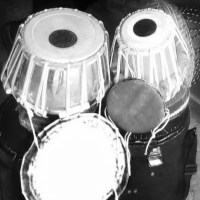
I am a social worker and percussionist and am at my happiest when combining the two. I was born and bred in the inner city of Nottingham, where my family were directly exposed to complex issues of race, poverty and disability, and from an early age I grew up steeped in the traditions of Indian classical music.

I chose to train as a social worker because I wanted an opportunity to support people to develop their independence and make their own choices and decisions. These principles were (and remain to this day) central to my belief system and I believe are the key values to social work and the provision of ethically sound practice. I have worked in hospital social work departments, community mental health teams, supported young people through their transitions into adulthood and over the last few years developing Co-production in mental health. My career to date has been based around my commitment to these goals. I am committed to community and passionate about service user involvement.


I chose Drum because …

… over 3 decades I have developed a facilitative practice where social justice, music, performance and the wellbeing of people intermingle. My work takes me into many situations, whether as trainer, consultant, academic, musician, percussionist, social worker, friend, depending on what the moment requires, we are united by a common purpose; to create an inclusive environment that energizes, enlivens, heals, and brings people together to feel better.

Drawing on my cultural and artistic influences from the Indian classical traditions of ‘Guru Shishya Parampara’ the drum has followed me every step of the way. It has allowed me to retain a creative practice in times of harsh realities of austerity and increasing bureaucracy and proceduralisation ­– I have drummed my way into the heart of social work practice with individuals and community groups communicating in the free flowing authentic way. The process has been like a simultaneous leap of faith from a world of thought and reason into the world of expression.

Individually or collectively handling this amorphous ball of energy that is coming off the drum, realising our wellbeing depends on it, giving a unique lesson in equality, sharing with others a lived experience with greater community cohesion and a ‘percussion discussion’ to have.

Footnote

In many Shamanic societies, if you came to a medicine person complaining of being disheartened, dispirited or depressed, they would ask one of these 4 questions:

  1. When did you stop dancing?
  2. When did you stop singing?
  3. When did you stop being enchanted by stories?
  4. When did you stop finding comfort in the sweet territory of silence?

Radio

  G I N E T T E   B E R T E A U

Ginette Berteau    93 Radio

I come from a large French-Canadian family with many cousins, aunts and uncles, and social support was extremely important in my family when I was growing up. I am convinced this focus on support is what led me to become a group worker. For the last forty years, social work with groups has been my passion and an integral part of my life. I first worked with groups of women, youth and parents. I later had a chance to train and oversee numerous social workers and group work students, which inspired me to pursue a PhD in the field. I have been teaching social work with groups at the Université de Québec à Montréal (UQAM) since 1999 in order to transmit my lifelong passion to future generations.


I chose Radio because …

… for me, social work is like a radio. Like the radio, social work must be in tune with its public, listen to what it has to say, continually explore new avenues to meet its needs and adjust itself, look for the most recent information to be able to offer a variety of choices, and multiple critics in terms of perspectives, cultures, opinions and interests while giving everyone the chance to adhere to what suits him or her best. Like radio, in addition to having an educational and awareness mission, social work must be connected to the world to remain up to date.

Bicycle

B I L L   B A D H A M

94 Bill Badham   94 Bike – Version 4

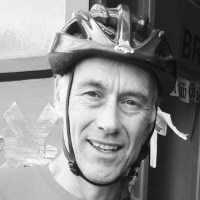
I came into social work through commitment to social justice, advocacy and support to those in difficulty. After qualifying in 1984, I worked in a community-based probation team in Nottingham, England, developing social action groupwork in prisons. Then with the Children’s Society, I ran a Children’s Centre, developing community social work and supervising social work students which I still do. I helped pioneer the voluntary sector MA specialism on Nottingham University’s social work course, lectured and published on social work, groupwork, the voluntary sector, youth offending, community development and young people’s participation. 35 years on, I remain passionate about and involved in community empowerment and social work practice.


I chose Bicycle because …

… it has accompanied me every step of the way through 35 years of social and community work practice. Lashing my trusty steed outside Nottingham Crown Court and stripping off soaking layers before being allowed entry to present before a judge, turning up to prisons near and far and locking up to a railing, cycling round the estates making home visits, getting knocked off my bike and then defending the driver in court, carrying laptops and projectors across cities for policy and conference presentations, turning up to community meetings and diving into the loo to get out of lycra before causing grief and consternation!

Too often the social worker is the aloof outsider, distant, remote, living in another world to that of those they work with and make crucial decisions about. The bike breaks down some of those barriers. You get to know the area rather than drive through it. The park, the corner shop, the places young people hang out – the fabric of the community you serve impresses itself. Who said that “revolution will only arrive on a bicycle?” Well this social worker certainly has arrived in many varied places on his bike and hopes to continue to do so.


Selfie

_group selfie for SW in 40 objects (1)

We, Unity, are the social work service users and carers group at the University of Stirling in Scotland. The group was established in 2005 and is made up of service users, carers, staff from partner agencies, student representatives and university teaching staff. We are involved in a range of teaching sessions on the qualifying social work programmes, and also with other activities like open days and developing case studies for use in selection. We have a newsletter and a website: http://unity.wordpress.stir.ac.uk/

We are developing our involvement in teaching student nurses and we are also involved in:

Events run by Stirling Students’ Union, for instance to mark Mental Health Awareness Week;

The Scottish Inter-University Service User and Carer Network: https://bettersocialwork.wordpress.com/

National events like conferences and research projects.


We chose Selfie (of some of the members of the group) because …

… social work is about people and it is about involvement. We took the photograph at one of our meetings, and not everyone was there. This made us think about the limitations of a ‘snapshot’ to represent who we are and what we do. We think that it is important for Unity, and also for social work, to recognise the missing voices and try to draw these in.

Continuing care guidelines

    A N N E   R U S S E L L

Tom Ann Jan Bolton Abbey   Continuign care guidelines

I trained in social work on one of the first degree courses in England and became one of the new breed of ‘generic’ social workers who were qualified in all areas of social work. This brave experiment fashioned my whole career and I had the privilege of working in many varied settings and experienced many different roles from child care, mental health, adult care and practice teaching.

The principle of working in partnership was paramount to me and it was the golden thread that ran through every aspect of my career: partnership with clients, social work colleagues and other organisations. I finished my career in a position that truly reflected this principle, being seconded from the Local Authority (LA) into the National Health Service (NHS) as a strategic regional manager.


I have chosen Continuing care guidelines because …

… it represents partnership working at the highest level. The UK Department of Health’s NHS Continuing Care guidelines policy covers one of the most contentious areas of joint working between the LA and the NHS and has been an area fraught with mistrust between the partner organisations due to the high costings involved. These national guidelines were first introduced in Oct 2007 and, although welcomed, the difficulties between the two organisations continued at the highest levels. However, following the development of a small advisory group of representatives from both health and social care, the 2009 updated guidelines were adopted by the two organisations and promoted by a national roadshow fronted by the mixed advisory group.

In a climate of great public funding restraints, tensions in this area remain but senior members of both organisations continue to work together in a spirit of partnership that didn’t exist prior to the development of that advisory group.

Compass (of shame)

M A J E L L A   H I C K E Y

Majella   Compass of shame

Growing up around a very caring, understanding, non-judgemental mother had a positive impact on my decision to go into social work. As a child I observed her deliver meals and cakes to elderly neighbours, tend to sick animals and volunteer on countless committees for disadvantaged groups in my community. I can relate to the pain of significant life experiences. I believe that the journey of resolution and healing helped me to become more aware, empathetic and understanding of my clients’ situations and struggles in overcoming pain and adversity and I believe my wound has become a gift to others.

I started work as a Community Development Worker with homeless people and addictions from 1999 – 2006. I felt a career in social work was a natural progression to the work I was already doing. I have been with the Probation Service in Dublin (the Young People’s Probation Service and in an Adult Supervision Team) ever since qualifying with a Masters in Social Work in 2008. Since qualifying as a practice teacher I have regularly supervised social work students and contribute to the training of future practice teachers at University College Cork.

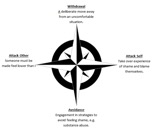
I have frequently felt perplexed in my attempts to build relationships with clients with challenging behaviours. For me, this has triggered feelings of inadequacy and failure. In seeking support, a supervisor introduced me to the concept of shame. Shame is an inner experience when private aspects of ourselves are unwillingly or unwittingly exposed or uncovered.[1] The compass of shame [2] describes the four scripts which we use to defend against feelings of shame. This compass helped me to make sense of my feelings, reactions and defences. It also helped me to understand my client’s reactions.


I chose a Compass (of shame) because …

 … knowledge and understanding of the compass of shame has helped me to identify and respond to the expression of shame both within myself and others. It has enhanced my relationships with people and enriched my professional career as a social work educator and practitioner.

The compass of shame is a tool used to describe the four ways in which people can experience and react to shame:

  • Those at the attack self point of the compass take over the experience of shame by engaging in self-deprecating behaviours. For example, listening to an internal voice that continues to put them down: “I am flawed”, “I am pathetic”.
  • Those at the attack other point of the compass attempt to distance themselves from the shame by blaming other people, making other people feel small or engaging in destructive behaviours. For example, acts of vandalism or public order.
  • Those at the withdrawal point of the compass retreat into themselves to hide away from the feelings of shame by removing themselves from the eyes of others. This helps avoid perceived judgement or scrutiny. For example, wanting a hole to open up and swallow them.
  • Those at the avoidance point of the compass engage in activities to draw attention away from the shame. For example, substance misuse, denial that the feelings exist.

[1] Loader, P (1998) A Consideration of Shame and Shaming mechanisms in Families, Child Abuse Review 7(1) : 44:57.

[2] Nathanson, D (1992) Shame and Pride : Affect Sex and the Birth of the Self, VW Norton & Company.

Panopticon

C A R O L I N E   M c G R E G O R

Caroline McGregor   91 Panopticon

I started my social work degree at the age of 17 in Trinity College Dublin and worked for a few years as a child protection social worker before pursuing a career in academia, where I have worked for over 20 years. Currently I am Professor and Director of Social Work at National University of Ireland at Galway. I research in the field of social work services and policy relating to children and families.


I chose Benthan’s Panopticon because …

… Michel Foucault’s use of it to depict surveillance and self-regulation is something that has greatly influenced my understanding of social work practice and theory. The idea of the Panopticon as a place from where you can see all of the subjects fits well with the idea of regulation in social work, especially with the idea of self-regulation: as the subjects never know whether they are being watched or not, they need to self-regulate.

This is interesting, of course, from the point of view of the surveillance society and the neo-liberal notion of Big Brother is watching. But it is not so much for this reason that I have chosen the object. It is for the more subtle understanding of self-regulation that it has taught me and that I have developed especially regarding child protection practice and training specifically thinking about deliberate abuse and harm. The ideal, when we think of care for children, is that as adults we self-regulate to ensure that we put children’s needs and interests first and do not cause them any deliberate harm. We do this all of the time as parents and carers in making decisions, and we do this for each other within families and communities.

If we could embrace the notion of self-regulation more widely, we could perhaps find a way to engage adults and communities more in sharing the responsibility for child protection and welfare. It would mean that we would have a system where adults who intentionally harm children and do not care about the consequences realize that they cannot get away with it. This should increase the chances that deliberate child harm, abuse, abduction and torture will move towards being significantly reduced if not eradicated into the future.

While being watched and regulated has many negative and sinister possibilities and effects, in some cases, like those where adults deliberately harm children without caring about the consequences, it is absolutely what we need!

Patch office door

    A N N I E   M A R S H

Jan Annie Pete   87 Patch office door

I really fell into social work as I had a year off in the middle of my degree as my mother was seriously ill. I was offered the job of social work assistant to the blind and loved it. On completion of my degree I got a job as a social work trainee for the London Borough of Camden where I was for 6 years, including two seconded years while I did my training. On moving to Sheffield I worked for 32 years in the Adoption team.

I have chosen the Patch office door because …

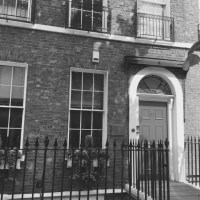
… it reflects a moment in the history of social work in England. No 52 Doughty Street WC1 was the Patch office for the southernmost part of Camden. Three teams, three small geographical areas. We covered all client groups following the Seebohm reforms and were ‘generic social workers’ – community workers one day, dealing with fostering the next, or mental health issues.

We did know our areas well and could respond to changes such as the arrival of Bangladeshi families joining their menfolk who worked in the restaurants. The families were helped by a community programme to manage the change from rural life to settling in the heart of London. Then there was the “posh” club that tried to connect lonely, increasingly disabled academics who lived in isolating bedsits. Our caseloads included cradle to grave and if I am honest the young families I had on my caseload got a better deal than other client groups as that was where my interest lay. What was great was having resources such as the council-run home help service in the same building, so a quick journey up or down the stairs could lead to finding out how someone was getting on after a hospital stay. Not many clients had phones and had to be contacted by letter.

Now social work is specialised and a family can have different social workers involved depending on the needs of people in the household. No doubt there will be calls for a more joined up approach.

… And the door at Number 52 now leads to commercial offices for literary agents. Times change.

Car

C A R O L I N E   P I C K A R D

88 Caroline Pickard    Car

I am a social worker, having worked a majority of my four year career in child protection in northern England. I am a practice development social worker, which is similar to being a practice educator, but on a wider basis – supporting social workers with their practice, through training, mentoring and coaching. As part of the Quality Assurance Team I also undertake auditing and quality assurance checks on case files and social work practice.

I never intended on being a social worker, but simply fell into it. I couldn’t love it more. It is one of the most rewarding, challenging and engaging jobs that could ever be done and I would be lost without my world of social work. I find the experience of being a social worker so enlightening and feel privileged to be involved in the lives of the families that I work with.


I chose Car because …

it is the same car that I have had since I have been a student social worker and I think that this is my “world” as a Social Worker. I have reflected, laughed, cried and done a lot of my job in the car – direct work, transporting people and discussions with service users. My car acts as an office, a safe place but also my space and it is vital to me being able to do my job properly; both emotionally and practically.